

Energy Rental vs. Staking TRX — Which Is Cheaper?
A side-by-side cost comparison of renting TRON energy versus staking your own TRX, covering capital lockup, flexibility, and break-even points.
If you regularly send USDT on TRON, you'll eventually have to choose: stake your own TRX to generate energy, or rent it on demand? Both have valid use cases. This article runs the numbers so you can decide.
The Fundamental Difference
| Dimension | Stake Your TRX | Rent Energy |
|---|---|---|
| Upfront capital | Usually 5,000+ TRX to cover one transfer | A few TRX |
| Capital lockup | Staked TRX locked for 14 days to unstake | None |
| Energy delivery | Accrues over time | Seconds |
| Flexibility | 14-day unstake delay | Pay-per-use, expires when done |
| Best for | Long-term, high-frequency users | Casual or burst usage |
Cost Walkthrough: 30 USDT Transfers per Month
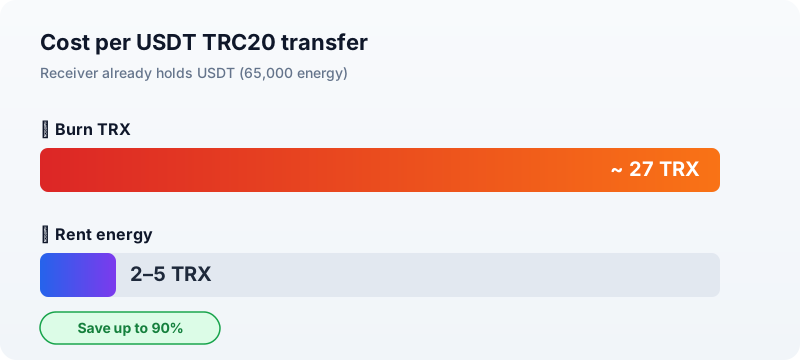
Assume each receiver already has USDT (≈ 65,000 energy per transfer).
Option A — Stake TRX
- Under current network conditions, staking 5,000 TRX generates roughly 65,000–100,000 energy/day
- That covers ~30–45 transfers per month
- But your 5,000 TRX is fully locked. With TRX's ~20% annualized volatility, the opportunity cost is roughly 1,000 TRX/year
Option B — Rent Energy
- At current market rates, one rental (1 hour) costs ~2–3 TRX
- 30 transfers/month ≈ 60–90 TRX/month, or 720–1,080 TRX/year
- Zero lockup; your TRX is free to trade or transfer
Bottom Line
- ≤ 30 transfers/month: Renting wins (no lockup)
- ≥ 50 transfers/month + long TRX holder: Staking wins
- Demand uncertain: Rent now, stake later when usage stabilizes
Renting Suits You If…
✅ You don't want to lock up TRX ✅ You only send occasionally or for one-off large transfers ✅ You run multiple wallets (merchant scenarios) ✅ You don't hold enough TRX to stake meaningfully
Staking Suits You If…
✅ You transfer daily (5+ per day) ✅ You already hold a large TRX position ✅ You participate deeply in the TRON ecosystem (voting rewards)
Hybrid Strategies Are Common
Many users stake a small base amount and rent on top during bursts. For example: stake 2,000 TRX for daily ≤10 transfers, and rent extra when a busy day hits 20–30.
Try Before You Stake
Not sure which side you're on? Just buy TRON energy on Tron4u, check the live price, and pay-as-you-go a few times. The cost of testing is effectively zero.
Summary
There's no universally "best" choice — only the one that fits your current usage. Casual senders should rent; long-term TRX holders with heavy usage should consider staking. The two aren't mutually exclusive: a hybrid often gives the lowest total cost.
Frequently asked questions
Is renting TRON energy cheaper than staking TRX?
For most users, yes. Staking requires locking 5,000+ TRX (with a 14-day unstake delay) to cover even one transfer, and the opportunity cost is roughly 1,000 TRX/year. Renting costs ~2-3 TRX per transfer with zero lockup. Staking only wins at very high transfer volumes.
How many transfers per month make staking worth it?
Renting 30 transfers/month costs about 60-90 TRX. Staking 5,000 TRX has an opportunity cost near 1,000 TRX/year. The break-even is high — unless you send energy-heavy volume daily, renting stays cheaper and far more flexible.
How long is TRX locked when staking for energy?
Staked TRX is locked and takes 14 days to unstake. During that window your capital is unavailable and exposed to TRX price volatility. Energy rental has no lockup — it expires when your time window ends.
Related posts
Cheapest TRON Energy Rental in 2026: Real Prices Compared
How much does TRON energy rental cost in 2026? Real price benchmarks: from 0.8 TRX per USDT transfer vs 13–27 TRX burned. What drives the price, what counts as cheap, and how to avoid overpaying.
How to Send USDT Without TRX for Network Fees (TRC20 Step-by-Step)
How to send USDT without TRX for network fees on TRON: rent ~65,000 energy from 0.8 TRX instead of burning 13–27 TRX. Works with TronLink and any wallet — no signup.
Best Telegram Bot to Rent TRON Energy in 2026 (From 0.8 TRX)
The best Telegram bot to rent TRON energy, and how to avoid seed-phrase scams: what a safe bot looks like, live quotes, delivery in seconds. Try @tron4u_bot — from 0.8 TRX per USDT transfer.